Short answer: Metaklisi (μετάκληση) is the legal way for a household in Greece to bring a worker from outside the EU to work for them on an Ε.4 residence permit. For a live-in domestic helper, the household applies to the Decentralised Administration covering its home, needs at least €22,000 gross annual income per worker, and pays the helper €920 net a month plus board and lodging. Expect 4–7 months to arrival.
Many families in Greece need steady help at home: someone who lives with them, keeps the household running and is there for the children or an older parent. When that person cannot be found locally, the legal route is metaklisi, the recall procedure (μετάκληση) for workers from non-EU countries. It works, but it is complicated and paperwork-heavy, with steps in two countries and two languages. Bridge Recruiters has handled it many times for households, and this guide explains, in plain English, how it works and how we take it off your hands.
What Is Metaklisi?
Metaklisi is the procedure by which an employer in Greece "recalls" a specific worker who lives outside the EU. It is set out in Law 5038/2023 (the Migration Code), as amended by Law 5275/2026. The order matters: the employer applies first in Greece, the worker receives a national type-D visa only after approval, and once in Greece the worker applies for an Ε.4 residence permit for dependent employment. The worker does not travel first and "sort it out later". Greece offers no route from a tourist visa to a work permit, and illegal stay is now a criminal offence.
For households, metaklisi is almost always used for one role: the live-in domestic helper.
What Can a Household Use Metaklisi For in 2026?
Metaklisi is only possible for specialties that appear in the annual admission quota. For 2026 this is set by Cabinet Act 35/2025 (ΠΥΣ 35/2025, Government Gazette Α΄ 241/2025). Out of a total of 94,240 places, 44,240 are for dependent employment (Ε.4). The quota is set per specialty, nationwide; there is no separate allocation per region.
- Domestic helpers (row 10.2, 1,500 places nationwide). This is the specialty for a live-in helper in a private home, and the focus of this guide.
- Care of an elderly family member. Light elderly companionship is part of a domestic helper's normal duties. If the main need is care for an elderly or disabled family member, the 2026 quota has a separate specialty, "Carers of the elderly and people with disabilities" (row 10.1, 1,000 places). We will tell you which one fits your situation before anything is filed.
Roles such as butler, private chef, private driver or personal assistant do not match a specialty that a private household can use in the 2026 quota. Each application covers one specialty, and the candidate profile has to match it.
Who Can Apply: Eligibility for Households
- The employer is a private individual or household. You hire the helper directly. Your household is the employer of record.
- Income threshold. As a private employer you need gross annual income of at least €22,000 per recalled worker, usually shown with your tax assessment (εκκαθαριστικό) or tax return.
- The worker comes from a non-EU country and is over 18. Most of the helpers we place come from the Philippines.
- The right authority. The application is filed with the Directorate for Aliens and Migration of the Decentralised Administration (Αποκεντρωμένη Διοίκηση) that covers the home where the helper will work.
- A legal employment contract with at least the statutory minimum wage and full social insurance. The minimum contract length was recently shortened by Law 5275/2026, but some official guidance still refers to one year, so we confirm the current requirement when we prepare your file.
- Accommodation. For a live-in helper you show that you can provide a room in your home.
The employer's file typically includes the metaklisi application, a copy of your ID or passport, your tax assessment as proof of income, the signed employment contract and proof of accommodation for a live-in worker. On the worker's side, the file needs a valid passport, references and certificates of experience, a medical certificate, a police clearance (NBI clearance for Filipino workers) and, for the Philippines, the OEC exit clearance.
How Bridge Recruiters Helps, Step by Step
- Needs assessment. We talk through your household, the duties, working hours, the room you offer and your timing, and check eligibility (income threshold, the right quota specialty, the competent Decentralised Administration).
- Candidate preselection. Through our licensed partner agency in the Philippines (licensed by the Department of Migrant Workers, DMW, formerly POEA), we shortlist candidates who match your needs. You interview them online and choose. This stage usually takes 2 weeks to 1 month.
- Paperwork and filing. We prepare the employer file, the payment of the state fee (e-paravolo) and the metaklisi application, and follow it until approval.
- Employment contract. We draft the contract with the agreed salary, duties, rest days and benefits, in line with Greek law and the Philippine requirements, including verification by the Migrant Workers Office (MWO, formerly POLO) at the Philippine Embassy in Athens.
- Visa coordination. After approval, our partner agency guides the helper through the medical exam, the OEC from the DMW and the type-D visa application at the Greek Embassy in the Philippines.
- Arrival and Ε.4 follow-up. We coordinate travel and arrival, guide you through the hire declaration and insurance, and follow the helper's online Ε.4 residence-permit application, which must be filed after entry and before the visa expires, until the permit card is issued.
Zero placement fee for the worker
Domestic workers pay no placement fee. Bridge Recruiters is based in Athens and works with DMW-licensed partner agencies in the Philippines for recruitment and deployment there.
What a Live-in Domestic Helper Does
Each household is different, so the duties are written into the contract. Typical responsibilities include:
- Daily cleaning and tidying of the home
- Laundry, ironing and care of clothes and linen
- Cooking, meal preparation and kitchen upkeep
- Grocery shopping and household errands
- Light childcare: school runs, meals, homework supervision, bedtime routines
- Companionship and day-to-day help for an older family member
- Pet care: feeding, walking, basic grooming
- Watering plants and general care of the home when the family is away
Be clear and realistic about the job before recruitment starts. A helper hired for housework is not a nurse. If someone in the family needs round-the-clock or medical-level care, tell us at the start so we choose the right specialty and candidate.
What the employer provides
- A private room in the home, and full board (meals)
- The agreed salary, paid on time every month
- Weekly rest days, rest hours and paid annual leave
- Full social insurance with e-EFKA from the first day of work
- The Christmas and Easter bonuses and the holiday allowance
- A respectful working environment; the helper keeps their own passport and documents
Salary and Costs
Monthly salary: €920 net
For a live-in domestic helper, the reference point in our proposals is €920 net per month, the amount the helper actually receives. Board and lodging are provided on top of the salary and are never deducted from it. The corresponding gross salary is higher than €920 and can never fall below the statutory minimum wage in force at the time.
What the employer pays on top
Employers often read "€920" and assume that is their total cost. It is not. In addition to the net salary, the employer bears:
- the difference between net and gross salary (the employee's contributions and tax),
- the employer's social-security contributions to e-EFKA,
- the Christmas and Easter bonuses, and
- the holiday allowance.
Employer cost at the €920 minimum wage
Calculated on the statutory minimum wage of €920 gross per month (from 1 April 2026) and the employer's EFKA contribution of 21.79%:
| Item | Per month | Per year |
|---|---|---|
| Gross salary (14 payments a year: 12 monthly + Christmas, Easter and holiday allowance) | €920.00 | €12,880.00 |
| Employer EFKA contributions (21.79%) | €200.47 | €2,806.55 |
| Total employer cost | €1,120.47 | €15,686.55 |
Every extra €100 of gross salary adds €121.79 to the monthly cost. If you agree a higher salary (for example €920 net, see above), the gross amount and the cost rise accordingly. We set out the exact figures for your contract before you sign. For the wider picture of domestic-helper pay in Greece, see our salary guide (in Greek) linked below.
ERGANI and EFKA: two separate obligations
ERGANI (ΕΡΓΑΝΗ) is the employment-declaration registry where hires are declared. e-EFKA (ΕΦΚΑ) is the social-security fund that collects contributions and provides healthcare cover. They are two different obligations and one does not replace the other. Domestic staff employed by a private household fall under a special EFKA regime, so the exact steps differ from a business hire. In practice: the hire must be declared and the worker insured before work starts, and we guide you through the declaration and registration.
One-off state costs
These are the state amounts for a dependent-employment metaklisi. They are the same for every non-EU country:
| Item | Amount | When |
|---|---|---|
| Metaklisi application fee (e-paravolo, code 2114), per worker | €200 | When the application is filed |
| Type-D national visa, consular fee | about €180 | Visa application, after approval |
| Ε.4 residence permit fee | €150 | After arrival |
| Residence permit card | €16 | After arrival |
| Airfare to Greece | depends on dates and route | Before departure |
The Ε.4 permit is a one-off fee, not a yearly one. The initial permit is valid for 3 years and can then be renewed for 5 years at a time. The full breakdown of state fees is in our state-fees guide (in Greek).
Bridge Recruiters' service fee
Our fee depends on your case: the specialty, the number of workers and the services you need. We do not publish a fixed price. Ask for a free personalised quote and we will set out every cost, ours and the state's, before you commit.
How Long Does It Take?
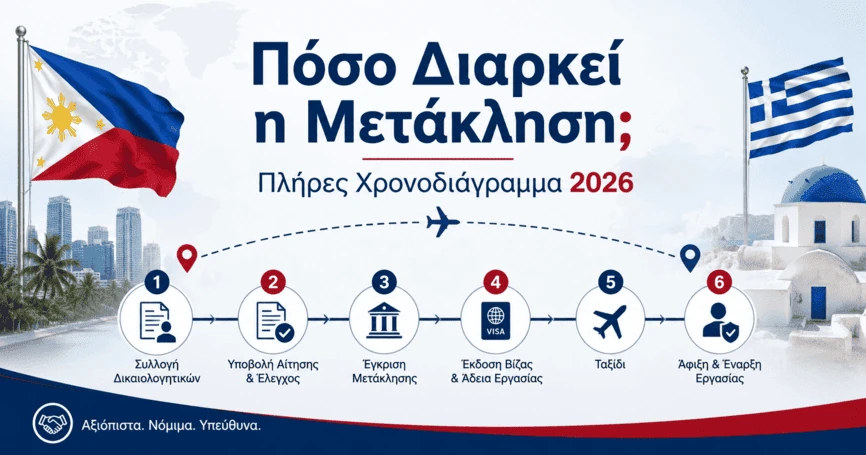
| Stage | Typical duration |
|---|---|
| Needs assessment, candidate preselection and interviews | 2 weeks – 1 month |
| Filing and approval by the Decentralised Administration | realistically 2–3 months (official estimate 50–60 days) |
| Contract verification, OEC, medical exam and type-D visa | the remaining weeks until departure |
| Total, from the start of the process to arrival in Greece | 4–7 months |
After arrival, allow another 1–3 months for the Ε.4 residence permit card. For a stage-by-stage timeline, see our metaklisi timeline (in Greek).
Most delays come from incomplete files. Our article on the common mistakes that lead to rejection (in Greek) covers the usual problems.
Frequently Asked Questions
What is metaklisi?
Metaklisi (μετάκληση) is the legal procedure for recalling a worker from a non-EU country to work in Greece under a dependent-employment (Ε.4) residence permit. It is governed by Law 5038/2023 (the Migration Code), as amended by Law 5275/2026. The employer applies first; the worker travels only after approval and a type-D visa.
Can a private household recall a live-in domestic helper?
Yes. Private individuals can recall a domestic helper under the 2026 quota specialty "Domestic helpers" (row 10.2, 1,500 places nationwide). As a private employer you need gross annual income of at least €22,000 per recalled worker, and the application is filed with the Decentralised Administration covering the home where the helper will work.
How much does a live-in domestic helper cost in Greece?
Our reference point is €920 net per month paid to the helper, with board and lodging provided on top and never deducted. The employer additionally pays the corresponding gross amount, employer EFKA contributions, the Christmas and Easter bonuses and the holiday allowance, so the real employer cost is higher than €920. The gross salary can never fall below the statutory minimum wage. At the €920 gross minimum wage, the total employer cost is €1,120.47 per month (€15,686.55 per year with 14 payments and employer EFKA at 21.79%).
Does the domestic helper pay a placement fee?
No. Domestic workers pay zero placement fee. Recruitment and processing costs are borne by the employer.
How long does metaklisi take?
Typically 4–7 months from the start of the process to the helper's arrival in Greece, plus about 1–3 months after arrival for the Ε.4 residence permit card to be issued. The longest stage is usually the Decentralised Administration approval, realistically 2–3 months.
What are the state fees for metaklisi?
The main state amounts are a €200 application fee per worker for dependent employment (e-paravolo code 2114), a consular fee of about €180 for the type-D visa, and €150 for the Ε.4 residence permit plus €16 for the permit card. Airfare is a separate cost.
How much does Bridge Recruiters charge?
Our service fee depends on your case and is given as a free personalised quote on request. Contact us through the employer form or at hello@bridgerecruiters.com.
Further Reading (in Greek)
- Metaklisi of a domestic helper in Greece: legal guide (in Greek)
- Domestic helper salary from the Philippines, 2026 (in Greek)
- Metaklisi state fees 2026: what the employer pays (in Greek)
- How long does metaklisi take? Timeline by stage (in Greek)
- Domestic staff for private residences (in Greek)
- Can you hire a Filipino worker directly, without an agency? (in Greek)
- What a staffing agency does: a guide for employers (in Greek)
Sources & official references
- Metaklisi of third-country nationals (Law 5038/2023, as amended by Law 5275/2026): Ministry of Migration & Asylum
- Ε.4 approval procedure and employer requirements: mitos.gov.gr, National Register of Administrative Procedures
- Overseas Employment Certificate (OEC): Department of Migrant Workers (DMW), Philippines
- Social-security contributions: e-EFKA, Employees
Looking for a Live-in Domestic Helper?
Legal metaklisi, fully managed by Bridge Recruiters, with a free personalised quote and a reply within 24 hours.
Fill in the English ApplicationPrefer Greek? Use the employer questionnaire. Or email hello@bridgerecruiters.com, call +30 210 444 5842 or +30 695 573 3971.